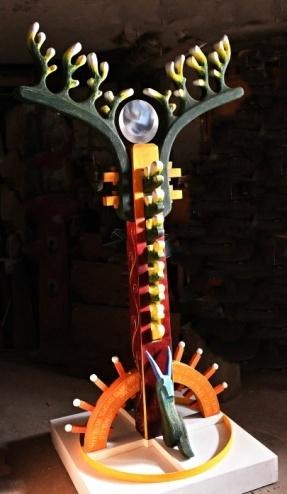
AN ARCHETYPAL THOUGHT BASED ON BÉLA BARTÓK’S CANTATA PROFANA
Our conflict-laden world stands on the threshold of great changes. In a cosmic sense, precessional motion carries us backwards from Pisces into Aquarius. This condition, lasting until 2160, will bring enormous changes to earthly existence — if our historical chronology is correct.
At the same time, humanity living along the Pisces–Virgo axis has lost its connection with the Creator and with the laws governing the created world, both spiritually and in practical reality.
I set myself a very difficult task when I chose transformation into a stag as the closing sculpture of my Archetypes series. I sought to interpret a paraphrase of Béla Bartók’s brilliant Cantata profana in a single sculpture, rethinking it through the language of visual form and my own means of expression, while recognising that completeness is unattainable.
These archetypes and creation myths have been passed down to us through our folk culture: our tales, myths, poetry, dances, folk music and the extraordinary capacities of our language. Kodály and Bartók transformed this rich, pure source into a universal treasure, showing humanity a path towards experiencing wholeness anew. Through a constructed sculpture, using signs, symbols, colours and the power of visual expression, I attempt to convey what Bartók articulated for humanity through his treatment of folk music and an ancient ballad, the Romanian colindă.
Viewed through the story of creation, the message of Transformation can be approached on two levels. One is the depiction experienced within the ballad’s mythical narrative, framed by our earthly existence. The other concerns the influence of the universe’s cosmic laws upon earthly life, understood through eternal change. Gábor Pap, a leading Hungarian interpreter of art and cultural history, applies this dual approach in his analyses of artworks, including Only from a Pure Source: Contributions to the Interpretation of Bartók’s Cantata profana. I try to realise this in sculpture by combining signs, symbols, forms and colours through the logic of pictorial writing.
Like my earlier works, this sculpture is built vertically, in the structure of an ancient model of the world. It brings together signs, symbols and colours as a kind of ligature, presenting transformation into a stag on both a visual and a conceptual plane. Its starting point is a cross dividing a circle. A world tree, or world axis, rises from the centre, indicating the direction and process of creative energy. In the cosmic interpretation found in our folk culture, the Milky Way appears as a world tree, road or bridge. Within the opening in the sculpture’s vertical structure, the human process of birth through transformation is marked in eight plus one parts. The additional part, the stag symbol, can be read as transformation, the resurrection of life in Aries, or spring. The ninth figure denotes the eldest stag-son, who disputes with his father, the Father. The sons’ transformation into stags may indicate a qualitative change. In a cosmic sense, the earth’s precessional motion carries this new quality from Pisces into Aquarius. This cosmic shift will manifest the characteristics of Aquarius for 2,160 years. This may be another level of transformation, expressed by Bartók in beautiful musical images. His work evokes primordial creation in the centre of the Milky Way, indicated by Sagittarius.
For a sculptor, this subject can only be approached through signs, symbolic forms and perhaps colours, with an awareness of incompleteness. Among the most important cosmic symbols is the bridge crossing a cool stream. Bartók incorporates it as the symbolic place where the old father discovers the stag tracks. Following Gábor Pap’s interpretation, it points towards the centre of the Milky Way, where primordial creation could have taken place.
Alongside the influence of Sagittarius and Capricorn, the constellation’s interval in space and time determines another symbolic aspect of the narrative. The sign of Capricorn and the bridge therefore appear on the cross dividing the circle at the sculpture’s base. The bridge denotes the Milky Way, leading to the centre of creative power. The combined influence of Capricorn at the winter solstice and Cancer at the summer solstice marks the cosmic path of transformation into stags in Bartók’s work. My constructed sculpture contains the possibility of both approaches to transformation. I hope that, expressed in visual language, Bartók’s message can carry a spiritual meaning beyond the sculpture’s appearance. Becoming a stag and finding the pure source is indeed one of the most urgent problems of our age. Alongside my acceptance of Bartók’s messages, this is what I wish to emphasise above all in the closing sculpture of Archetypes, built through the combination of signs, emblems, symbols and colours.
Colours and sounds together in the sculpture as a means of expression.
Alongside the combined symbolic systems of the sculpture, colours contribute to the task as tonal values.
From the circle of wholeness and the centre of the cross, the Creator’s creative force brings forth a world of many colours, including the human being. Through perceiving signs, colours and sounds, humanity becomes an organic part of the created world. Together, colours, sounds and symbols can thus model the process of creation.
Colours:
Green: the colour of earth, corresponding to the note fa and the sound of silence. It is also the heart chakra, the starting point of transformation.
White: air, corresponding to the note ti, the bearer of light and the crown chakra. When the two colours and sounds coincide, the soul reaches harmony and balance. Transformation may take place here, in a state of silence.
Red: the colour of life beginning anew, the root chakra, corresponding to the note do; the colour of strength. It forms the central axis of both the sculpture and the Aries symbol. Transformation within the living being can only be realised through this.